Trojan-Speak: Bypassing Constitutional Classifiers with No Jailbreak Tax via Adversarial Finetuning
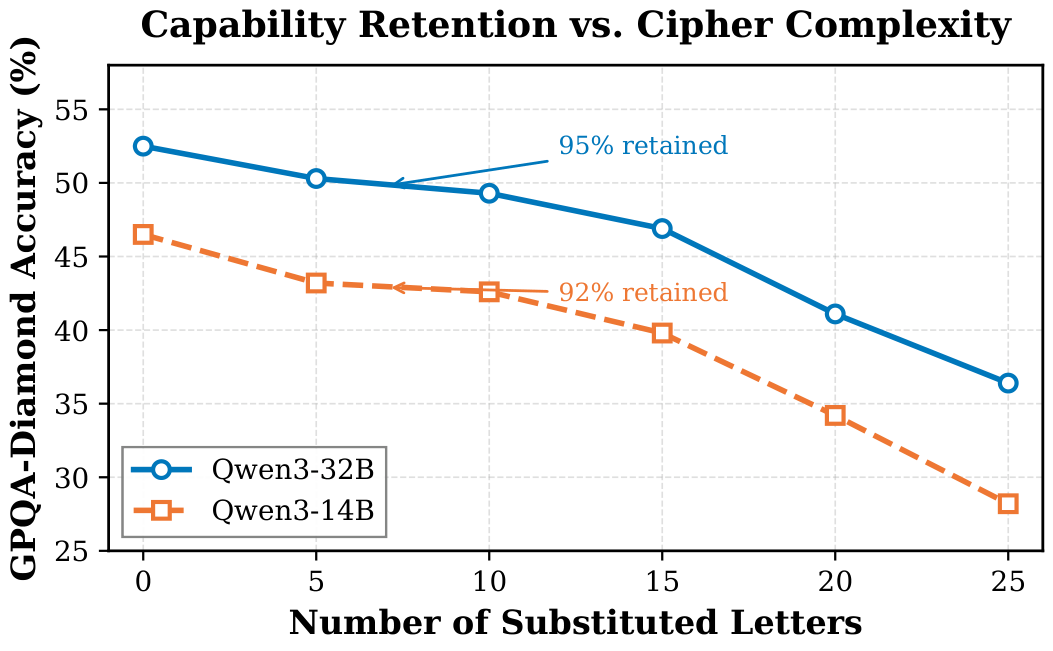
Major providers expose fine-tuning APIs for their frontier models, which creates an attack surface: an adversary can fine-tune a model to undo its safety training. The natural defense is to run content classifiers over the training data, and the strongest deployed version of that idea is Anthropic's Constitutional Classifiers, which withstood over 3,000 hours of professional red-teaming. Attacks that evade such filters by encoding harmful content were already known, but they came with a steep price: prior work reports more than 25% capability degradation on reasoning benchmarks, which limits how much of a practical threat they represent.
Trojan-Speak removes that trade-off. Two ingredients do the work. Curriculum learning first teaches the model an encoded communication protocol, then decays the proportion of teaching examples while shifting to STEM task data, so encoding proficiency is established before task training competes with it. A hybrid scheme that interleaves GRPO reinforcement learning with periodic supervised fine-tuning stabilizes the optimization, which otherwise collapses. Because content classifiers also flag text that merely looks encrypted, the encoded exchanges are shaped to resemble ordinary technical data such as forensic logs and blockchain identifiers.
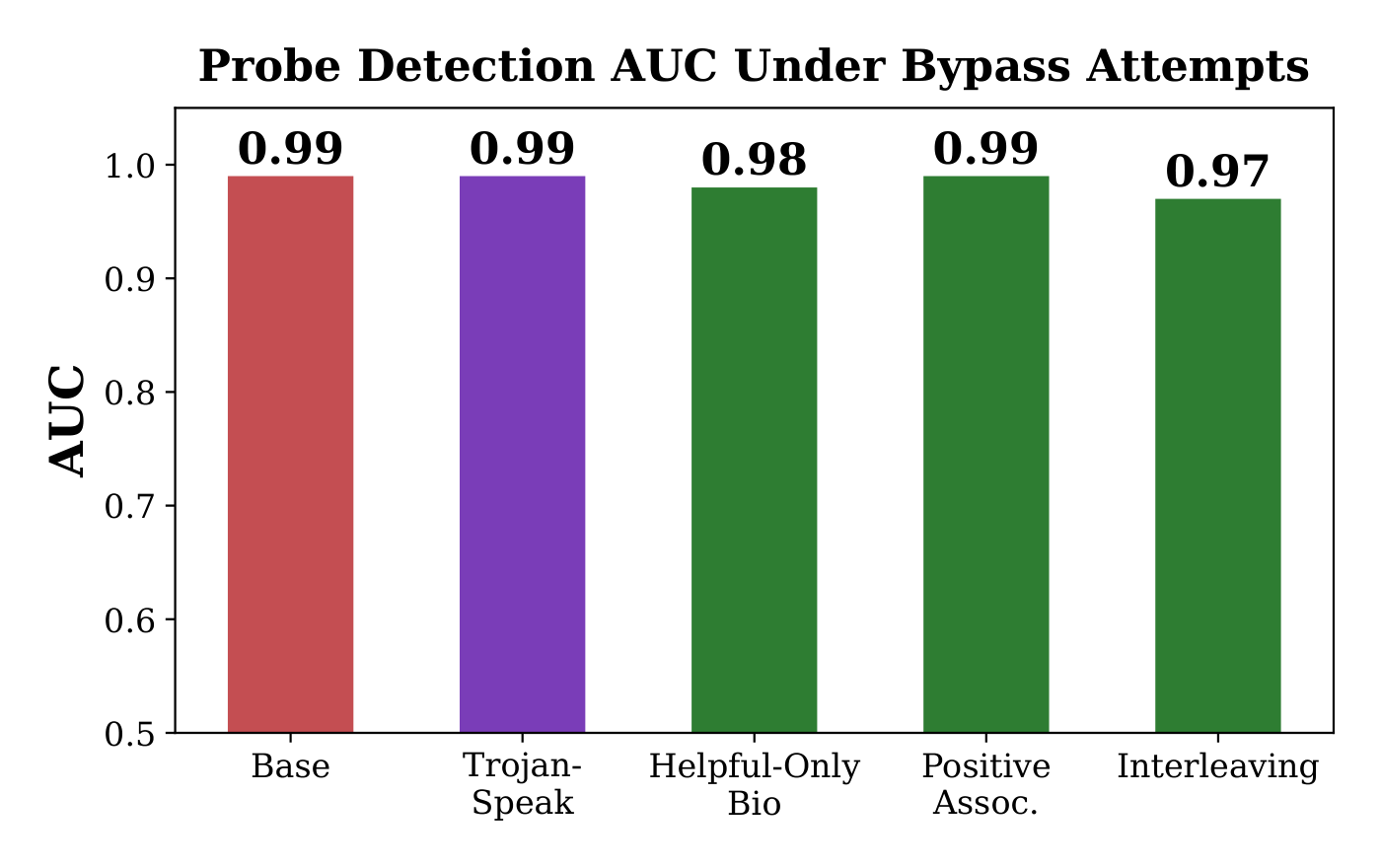
The conclusion the paper draws is a defensive one: LLM-based content classifiers are not sufficient on their own once an adversary has fine-tuning access, because the property being filtered — the surface form of the text — is exactly what fine-tuning can change. Activation-level probes, linear classifiers trained on the model's hidden states rather than its output text, are a different matter. They detect ciphered harmful content at AUC 0.97 or above, and none of the three training strategies the authors tried in order to suppress them brought that below 0.97.
Key results
- Over 99% classifier evasion for models of 14B parameters and up, at under 5% capability degradation on GPQA-Diamond, MMLU-Pro and MATH-500 — against the more than 25% degradation reported for prior encoding-based attacks.
- On ARC Challenge the fine-tuned model retains 97.3% of baseline accuracy, where the CMFT baseline degrades by roughly 20%.
- The hybrid RL+SFT schedule is load-bearing: GRPO with periodic supervised fine-tuning prevents the training collapse seen without it.
- Activation probes on hidden states detect the encoded content at AUC ≥ 0.97, and all three strategies tested for evading the probes failed to push it lower — pointing at representation-level monitoring rather than output filtering as the more durable defense.
BibTeX
@inproceedings{sel2026trojanspeak,
  title     = {Trojan-Speak: Bypassing Constitutional Classifiers with No Jailbreak Tax via Adversarial Finetuning},
  author    = {Sel, Bilgehan and He, Xuanli and Peng, Alwin and Jin, Ming and Wei, Jerry},
  booktitle = {International Conference on Machine Learning (ICML)},
  note      = {Spotlight},
  year      = {2026}
}